



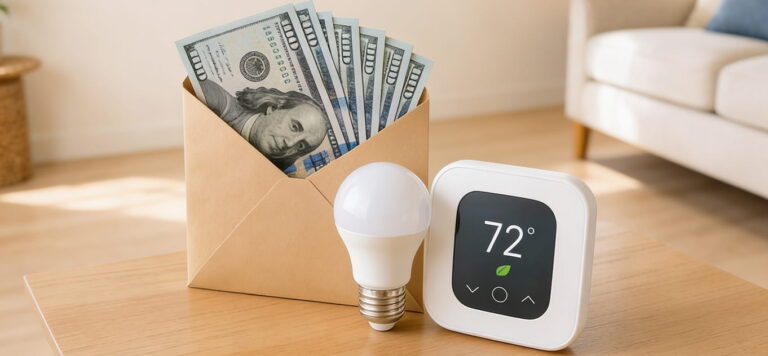
Tax refunds are landing in bank accounts across Texas right now, and for most people, that money disappears into the general flow of bills and expenses within a week or two. But if you are a prepaid electricity customer heading into what is expected to be an expensive summer on the Texas grid, there is a smarter play: invest a small portion of that refund into upgrades that will pay you back every month in lower energy costs.
Today is also Earth Day, which makes this a good moment to think about the overlap between saving money and reducing energy waste. Every kilowatt-hour you do not use is one less kilowatt-hour the grid has to generate. Here are five concrete ways to turn a portion of your tax refund into real, measurable savings on your electric bill this summer.
1. Pre-Load Your Prepaid Account With a Summer Buffer
This is the simplest move on the list, and it is the one most likely to keep you out of trouble. Texas summers are expensive. Daily electricity costs can double or triple compared to spring, and on a prepaid plan, a depleted balance means a service interruption.
Take $50 to $100 of your refund and load it onto your Now Power account as a summer cushion. This is not money spent—it is money staged. It sits in your account and gets used over time as your normal electricity consumption happens. The difference is that you are not scrambling to top up during a heat wave when every other expense is also spiking. You have already covered the hardest weeks of the year.
2. Buy a Smart Thermostat ($80 to $150)
A programmable or smart thermostat is probably the single best energy investment a Texas household can make. The Department of Energy estimates that properly using a programmable thermostat can save roughly 10 percent on heating and cooling costs annually. For a Texas household that spends $200 per month on electricity in summer, that is $20 per month—the thermostat pays for itself within two months.
For renters, many smart thermostats install without new wiring and can be removed when you move. Just save the original thermostat and reinstall it before leaving. Pair the smart thermostat with Now Power’s Free Nights plan, and you can program it to cool aggressively from 9 p.m. to 5:59 a.m. when energy is free (transmission and delivery charges still apply), then ease off during the day. That automation alone is worth the price of the device.
3. Swap Every Bulb to LED ($15 to $30 for a Whole Home)
If you still have incandescent or CFL bulbs anywhere in your home, this is the fastest dollar-for-dollar return you will find. LED bulbs use approximately 75 percent less energy than incandescents and last 15 to 25 times longer. A 10-watt LED produces the same light as a 60-watt incandescent.
Replacing the 10 most-used bulbs in your home costs under $20 at most Texas retailers and can save $50 to $100 per year. That is not a projection—it is basic math. If each bulb runs five hours per day, you save about 50 watts per bulb per day, which is half a kilowatt-hour. Across 10 bulbs, that is 5 kWh per day, or roughly 150 kWh per month. At typical Texas rates, that translates to real money off your bill.
4. Install Blackout Curtains on West-Facing Windows ($30 to $60)
Windows are the biggest weak point in any home’s thermal envelope. In a Texas summer, west-facing and south-facing windows can turn a room into an oven by late afternoon, forcing your AC to work overtime. The Department of Energy estimates that blackout or thermal curtains can reduce heat gain through windows by 24 to 33 percent.
A set of blackout curtains for one or two windows costs between $15 and $30 per window and installs with a basic curtain rod. For renters, this is completely non-destructive and moves with you. Prioritize windows that get direct afternoon sun—that is where the heat load is highest and where the curtains will have the most impact on your cooling bill.
5. Replace Weatherstripping on Exterior Doors ($8 to $15)
Gaps around doors and windows let cooled air escape and hot air seep in. Over the course of a Texas summer, those small leaks add up to significant waste. A roll of adhesive weatherstripping costs under $10 and takes 15 to 20 minutes to apply around a standard door frame.
Use the dollar-bill test to find the worst offenders: close a bill in the door, and if you can pull it out without resistance, that seal needs attention. Focus on exterior doors first (front door, back door, garage entry), then move to windows if you have leftover material. This is one of those fixes that costs almost nothing, takes no skill, and immediately reduces how hard your AC has to work.
The Math: What These Investments Add Up To
If you do all five—pre-load your account, install a smart thermostat, switch to LEDs, hang blackout curtains, and replace weatherstripping—you are looking at a total investment of roughly $180 to $350. The combined energy savings from the thermostat, bulbs, curtains, and weatherstripping can realistically reduce your cooling costs by 20 to 30 percent over the summer months.
On a Free Nights plan from Now Power, where the energy charge is already zero from 9 p.m. to 5:59 a.m. (with transmission and delivery charges still applying), these upgrades focus their impact on the daytime hours when you are actually paying the full energy rate. That is where every efficiency gain hits hardest. A modest tax refund, spent deliberately, can offset rising Texas electricity costs for the rest of the year.
Frequently Asked Questions
1: What is the best way to use my tax refund to lower electricity costs?
The highest-ROI move for prepaid customers is pre-loading your account with a summer buffer, then investing in a smart thermostat, LED bulbs, blackout curtains, and weatherstripping. Combined, these upgrades can reduce cooling costs by 20 to 30 percent.
2: Can renters install a smart thermostat in Texas?
Yes. Many smart thermostats install without new wiring and can be removed when you move. Save the original thermostat and reinstall it before leaving. Always check your lease or ask your landlord first, but most have no objection since it improves the property.
3: How much can LED bulbs save on my electric bill?
LED bulbs use approximately 75 percent less energy than incandescents and last 15 to 25 times longer. Replacing the 10 most-used bulbs in a home can save around $50 to $100 per year in energy costs.
4: Do blackout curtains really save energy?
Yes. Blackout curtains can reduce heat gain through windows by 24 to 33 percent according to the Department of Energy. West-facing and south-facing windows provide the largest benefit in Texas because they receive the most direct summer sun.
5: What is a Free Nights electricity plan?
A Free Nights plan like Now Power’s charges zero for the energy portion of your bill between 9 p.m. and 5:59 a.m. Transmission and delivery charges from your local utility still apply during all hours. This plan is especially valuable in summer when you can pre-cool your home overnight using free energy hours.